Category: Creativity

  • Africa Project – Part 1

    as told by our favorite Art Coach, Bruce Hucko

    Africa, The Book is a celebration of an artistic collaboration that took place at Helen M. Knight Elementary School in Moab, Utah during the 2019-2020 School Year. It centers on the creative energy of Mrs. Charlotte Quigley’s 3rd Grade class. It involves the school’s inspired music teacher Sheila Strahan and BTSALP-Visual Art Specialist Art Coach Bruce Hucko.

    The Adventure began when –

    Mrs. Quigley’s 3rd Grade class was reading folk tales as part of their social studies curriculum. Good teacher that she is, Mrs. Quigley saw the opportunity for creativity and had her students write their own folk tales. Putting into practice what they learned about the characteristics of folk tales by writing one creates deep learning. They must have done a great job because the next thing Mrs. Quigley did was to meet with music teacher Sheila Strahan about doing an opera. When she taught kindergarten and 1st grade, Ms. Sheila’s classes and others produced student-written and performed operas. When she accepted the music post she brought those skills along and let the staff know she was ready to collaborate. Opera brings music, song, dance, theater, literature and the visual arts together in a most wonderful way, especially when it involves kids!

    Mrs. Quigley suggested that student folk tales be used and Sheila enthusiastically agreed. Our “African Queens” (though they really are princesses) are Maddi, Olivia, Liesel and Ellie. They were asked to adapt their tales into a play which meant creating speech and assigning that speech to enough characters that the whole class would be involved. They worked many a morning and lunch recess to perfect their work. They then met with Sheila who edited and adapted them into the operatic format.

    Students were invited to select the characters they wanted to play in each operetta. Sheila then worked with the class and individuals on their singing parts, wrote the music and then taught all students the music and the interlude dances. Sheila spent the summer of 2018 in Ghana, Africa studying tribal music and dance and now she was able to apply her new knowledge too!

    They then came knocking on my door and it took maybe 3 seconds to get on board. The idea for pizza masks came easily. I had a few in my room from years before and was eager to do it again. This was the class! So that the entire 3rd Grade could be involved, but without the supplies and intensity of Mrs. Q’s class I centered on paper collage and printing. It worked out great.

    While the masks were being made, songs were being practiced and dance moves perfected. Their was a heightened sense of excitement whenever class gathered.

    Mask Making

    Our work began with a PowerPoint on the mask culture in Africa. I started with a poster image from the movie “Black Panther.” Most all of the kids were quite familiar with it. The second slide was a museum photo of a real African panther mask that was 300 years old. Slides and video of African masks in ceremonial dance use revealed that masks not only represented an animal, deity, or other natural element, but that they also required their own movement. While studying masks the kids were also introduced to the life of Nelson Mandela, the number of languages spoken in Africa (over 1500), its size (4x United States), as well as art concepts of Pattern, Design, and Color Contrast.  Students next created wonderful paper designs for the mask character the operettas required. And then –

    Your homework. Tell your parents that Art Coach “requires” that you order a take-out pizza. Eat it if you want, BUT you must bring the box to school.

    Thus began the building process. We had plenty of purchased and gifted pizza boxes. We also had a number of dedicated parents who came to help design, cut and glue for 2-3 art sessions. A big thanks to the parents of Maddi, Annabelle, Shycee and others. Kids come in all ages you know, and these parents prove it!

    The young artists were challenged to have the primary features stand in relief from the cardboard base. This required novel engineering and gluing skills. Eyes, pupils, eyebrows, ears, horns, tusks, mouth, teeth, nose, trunk and whatever else needed to be on the creature were drawn, cut, and glued into place.

    Base colors were applied during the first of 3 paint and decoration sessions. I wished you could have witnessed the 2nd paint session. It was one of the most potently creative and energetic arts sessions with children that I’ve ever encountered. You could hold the energy like an apple and bite it! Wow! Everyone brought their best game. The focus on painting their details was intense. The excitement palpable.

    Paper Masks and Printing

    As Mrs. Quigley’s class was writing and practicing their operettas the four other 3rd grade classes at HMK had their part to do also. Their “mask” project involved 3D paper collage and pattern printing using jute wrapped lengths of 2×4 dipped in tempera paint.

    The paper collage provided the opportunity to manipulate paper. The challenge, like with the pizza box masks, was for students to create as many parts of an animal or humanesque face as they could out of different pieces of paper, AND to give the mask some relief by inventing techniques to raise the paper. They took to it with a particular creative hunger that was quite thrilling to be around.

    We had shiny, metallic paper, standard construction paper, wall paper samples, bright card stock and whatever else I had on hand. Standard and craft scissors, along with good old tearing were employed.

    The printing element was borrowed and altered from something I saw on Pinterest. African mudcloth was the primary inspiration. Instead of the traditional method, we used jute wrapped around a 6″ length of 2×4. Each child received a block of wood and about 6′ of jute. The jute is wrapped in any direction to create a design. The sides of the 2×4 are then taped down so they don’t move. Each of my students had two pieces of 18×24 drawing paper to make their prints. I asked them to make their first print with ONLY ONE COLOR and then they could use different colors on the second one. I soon had to abandon that bit of “control.” Once they understood the process they immediately started pouring designs of color in the foam plates we use for holding paint.

    The crowded cacophony that erupted was really music to my ears! Everyone was experimenting, sharing and supporting each other. Though I’d started the day playing Pandora’s African Drumming in the background the “drumming” of print block to table created it’s own productive rhythm for the day.

    When finished students were asked to give their mask an African sounding name. They could make something up or rearrange letters of their name like Kenzi did.

  • The Day the Crayons Quit

    Debbie Beninati, BTSALP Music specialist at Sandy Elementary School in Canyons School district wrote two original songs and one original rap for a production of The Day the Crayons Quit. Students in the after school program did the rest: staging, casting, orchestrating on Orff instruments, painting protest signs for the crayons to carry, and creating art work that accompanied the story. Their only “script” was the text of the story, The Day the Crayons Quit , by Drew Daywalt.  Safe to say it was a SMASH HIT!

  • Love and Awesomeness

    Zoe Bennion (10 years old,) a fifth grader at Rosemond Elementary School in Jordan School District and her sister Mia (5 years old,) a Kindergartner at Foothills Elementary also in Jordan School District made a slide show to make all the teachers in Utah happy! Trust me, it does just that!

    BTSALP’s website designer, Anneliese Bennion took the LOVE up a notch by creating the . . . Awesome project for teachers, parents and creative spirits of all ages!! Check it out below.

  • Enoch Arts Night

    Enoch Arts Night (Title 1 Family Engagement Night) for Enoch Elementary in the Iron County School District under the direction of BTSALP Visual Arts Specialist, Kirsten Anderson, Principal, Daniel Ekker, and Reading Specialist, Marcy Christensen was held on Monday, February 10th. It was a wonderful night FULL of creativity and fun!

    The event featured a large student art show full of the arts integrated projects the students had been working on since the beginning of the year.  There were trainings for parents on how to best support their students academically and emotionally.  The SUU Play Team was in attendance to play theater games with students. Students participated in a visual art “make and take” activity called Book Buddies. Students made a box that held a book, then decorated it any way they wanted.  This activity had students thinking “outside of the box.”  Families could be heard throughout the halls creating African rhythms with drums, and the wonderful Enoch Elementary Choir also performed.  

    4th Grade Houses and Pots

    5th Grade Sgraffito Pots

    Mosaics and Drumming

    Book Buddies

    Making Book Buddies

    Tunnel Book Self Portraits and Team Games

    Heat Masks and Close Up of Tunnel Book Self Portrait

    Enoch Choir

  • Do Art To Be Smart

    The Granite School District Art Gallery is currently showing art from BTSALP students. The exhibit – Do Art To Be Smart – will be on display until January 31, 2020. Images below are just a “sneak peek” into the creativity of BTSALP students!

    The following Specialists shared integrated art pieces created by their elementary school students.

    • Sheryl Larsen, Cottonwood & Howard R. Driggs
    • Lucille Stearman, Plymouth & Freemont
    • Cynthia Micken, Copper Hills & Magna
    • Catherine Widner, Pioneer & Jim Bridger
    • James Camargo, Elk Run & Jackling

    Geometric and Organic Line and Shape, Grades K-6 – BTSALP Specialist, Lucille Stearman

    Positive and Negative Leaf Prints, 3rd Grade – BTSALP Specialist, Sheryl Larsen

    Geometric and Organic Shapes, Grades K-6 – BTSALP Specialist, Lucille Stearman.

    Mask Making, – BTSALP Specialist, James Camargo.

    Aspen Trees, 4th Grade – BTSALP Specialist, Cynthia Micken

    Sedimentary Rock Arch Paper Collage , 2nd Grade – BTSALP Specialist, Catherine Widner

    Sedimentary Rock Arch Painting, 4th Grade – BTSALP Specialist, Catherine Widner

    Animal Collage, 4th Grade – BTSALP Specialist, Sheryl Larsen

  • A Day at Thunder Ridge: Part 2

    Robert Smith, BTSALP and Alpine School District Coach, is back guiding the 4th grade students in Ms. Mickelsen’s class through a session of scientific sketching and drawing. Topic: Butterflies!

    Scientific drawing require the artist to look at things through the eyes of a scientist. Charles Darwin was a scientist who was also an artist. He studied plants and animals and drew them in an accurate and detailed way.

    Boxes of butterflies, beetles and other creatures can be checked out from the Museum of Natural History on the University of Utah campus.

  • All In The Family

    Spencer and Camilla Duncan are BTSALP Drama specialists and . . . they are also husband and wife! Spencer teaches at Copper Canyon Elementary and Elk Meadows Elementary in the Jordan School District while Camilla is at Edgemont Elementary and Park Lane Elementary in the Canyons School District.

    Spencer’s sixth grade class Copper Canyon have been studying and acting out the Egyptian myth of Osiris during drama class this month. Below is a short synopsis of the Egyptian myth.

    The Osiris myth is the most elaborate and influential story in ancient Egyptian mythology. It concerns the murder of the god Osiris, a primeval king of Egypt, and its consequences. Osiris’s murderer, his brother Set, usurps his throne. Meanwhile, Osiris’s wife Isis restores her husband’s body, allowing him to posthumously conceive their son, Horus. The remainder of the story focuses on Horus, the product of the union of Isis and Osiris, who is at first a vulnerable child protected by his mother and then becomes Set’s rival for the throne. Their often violent conflict ends with Horus’s triumph, which restores Maat (cosmic and social order) to Egypt after Set’s unrighteous reign and completes the process of Osiris’s resurrection.

    From right to left: Isis, her husband Osiris, and their son Horus, the protagonists of the Osiris myth

    “Death on the Nile River”

    Camilla Duncan uses the book, Cloudy With a Chance of Meatballs, to integrate problem solving , weather and simple machines with her 4th graders at Park Lane Elementary. After a quick warm up, students discuss issues in their imaginary town, Burgertown. How will they clean up all the food that has fallen from the sky? What types of machines can they create that could solve Burgertown’s sanitation problem?

    Group Assignment for the Day: Physically create a machine that can solve the problem. Explain how your machine works (Sound effects appreciated!) Name your machine.

  • Utah Birds and Ecosystems

    This Fall, 2019 the Artsbridge Honors course at Weber State University will design and co-create a new faux-stained glass installation called Utah Birds & Ecosystems. This is a course designed for Weber State University students to work closely with professors and BTSALP Visual Arts Specialist, Brent Rhodes, and his 4th graders at James Madison Elementary. Through this collaboration students design and build a hanging installation that depicts the birds and ecosystems found in Utah. This aligns with the 4th grade Utah State Science Standards. All of the Weber State students and 4th Graders will visit the Ogden Nature Center to gather field research on Utah’s birds and ecosystems. They will work closely with local artists to inform and develop their artistic process. Throughout the semester, students will also engage in pen-pal writing prompts, strengthen their knowledge in the elements of art and explore a variety of art techniques.

    This display will be permanently hung at James Madison Elementary School and is facilitated by Tamara Goldbogen, Erinne Roundy, and Brent Rhodes. This project is a partnership between the Weber State University Arts Learning Collaborative, the Ogden Nature Center, and the Beverley Taylor Sorenson Arts Learning Program.

    Mark your calendar: The semester and course will culminate in an unveiling of the Utah Birds & Ecosystems faux-stained glass installation and a short documentary on the creative process on Wednesday, December 11, 2019 from 5:00-6:30pm at James Madison Elementary School in Ogden Utah. This event is open to the public and all are welcome to celebrate the hard work and success of both students and faculty.

  • A Day at Thunder Ridge: Part 1

    BTSALP and Alpine School District Coach, Robert Smith is a man of many talents. Follow along as he guides Mrs. Everitt’s Kindergarten class in some drawing exercises on National Dot Day!

    “We are learning to tell stories with pictures. Artists use exercises and mark making to strengthen the muscles in their hands. It improves our drawing.”

    Mr. Smith puts on the music, first a lullaby and then some . . . Super Hero music and students take their pencils dancing!

    Group and Peer critique is an important part of the art lesson. First students respond to the question, What is the same about these lines? What is different? Then it’s time for Peer Critique where students look for similarities and differences in others work.

    Be on the lookout for more with Robert Smith in Thunder Ridge Parts 2 and 3

  • People Who Attend Cultural Events Are Happier

    A new study found on artnetnews.com discusses research commissioned by Arts Council England that makes the case for why smaller towns should amp up and promote their arts offerings.

    Kate Brown, August 26, 2019

    File this under things you probably intrinsically knew but now have data to support: arts and culture really do go a long way toward making people feel content.

    A new study in the UK has quantified just how much arts offerings influence people’s choice to relocate or stay in a particular city. And as it turns out, the presence of arts and culture overwhelmingly affected respondents’ sense of well-being and satisfaction, their attachment to a place, and their sense of community. In fact, citizens gave as much weight to the presence of culture as the presence of good schools when making a decision about where to settle.

    “A strong arts and cultural offer makes people feel more content and thus more likely to stay within an area,” the study’s authors write. “Accounting for a range of factors that influence life satisfaction, people attending a wider range of arts and cultural events are more satisfied with their lives than people who don’t.”

    The study, titled “Value of Arts and Culture in Place-Shaping,” examined 1,756 responses to a UK-wide survey conducted in 2017. Conducted by the research company Wavehill Ltd. and commissioned by Arts Council England, the report not only makes a good case for community arts funding, but also suggests that the arts could be used to help draw new residents to smaller towns.

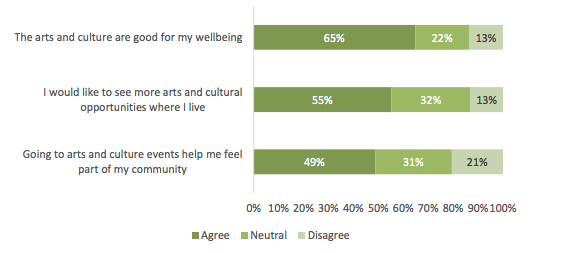
    Some 68 percent of respondents stated that arts and cultural events were very important for helping them feel part of their community. Over half would like to see more offerings in their area. And nearly two-thirds said that arts and culture were good for their personal well-being. (Interestingly, a smaller share—36 percent—classified arts and culture as “essential to life.”)

    “The hard evidence shows that the arts matter to people across the country, and makes clear the case for greater investment in culture,” former Tate director and Arts Council England chair Nicholas Serota wrote in an essay about the findings for the Guardian.

    Screenshot of the Arts Council England’s findings.

    The study focused on how arts and culture affected residents’ desire to relocate to or stay in cities across the UK. In addition to the survey, the authors also conducted interviews with residents and business owners in six smaller or mid-size cities outside of London: Birmingham, Halifax, Hastings, Redruth, Southam, and Stoke-on-Trent.

    The findings offer a potential avenue for development in cities that have previously relied on manufacturing or other now-dwindling industries. In order to attract new residents, the study suggests, towns might consider emphasizing their creative assets.

    “[M]any towns that once had thriving high streets and commercial centers are experiencing a loss of confidence and a changing sense of identity,” Serota wrote. “The presence of a theater, a gallery, or a library—places where people gather to enjoy themselves and share an experience—can help to sustain towns through the transformations of our age.”

    Serota added that he found it “heartening” that Boris Johnson acknowledged the key role arts and culture had played in enhancing the reputation of Manchester in one of his first speeches as UK prime minister.

    Below are some additional key takeaways from the Arts Council England study.

    • Art is crucial to community-building. A whopping 65 percent of respondents said that art is very important to establishing a sense of community. Overall, respondents highlighted arts and culture in relation to community integration, fostering a sense of collective identity, space for interaction, and shared experience.
    • Art and culture can draw new residents. Forty-four percent of respondents said that the quality of artistic and cultural offerings would influence their decision to stay in a place, while 43 percent said it affects their decision to move. Both of these figures were roughly equivalent to the importance placed on the quality of schools in a city. The study suggests that cities seeking newcomers need to promote their exclusive arts offerings as part of their marketing strategy.
    • Art is essential to well-being. Forty-nine percent of respondents said that attending arts and culture events helped them feel a part of their community—which enhanced their sense of well-being—while 55 percent wanted to see more offerings.
    • Businesses find it a little less “essential.” While individuals overwhelmingly emphasized the importance of creative projects on their happiness in a given city, businesses had a more mixed response. Some noted that arts offerings help attract young professionals and graduates and raise the profile of a city for skilled foreign workers. But many said other things were more important, like local schools. The researchers suggested that arts and cultural organizations should engage local businesses in dialogue about potential collaboration and sponsorship opportunities to encourage them to feel as invested in their success as individuals are.